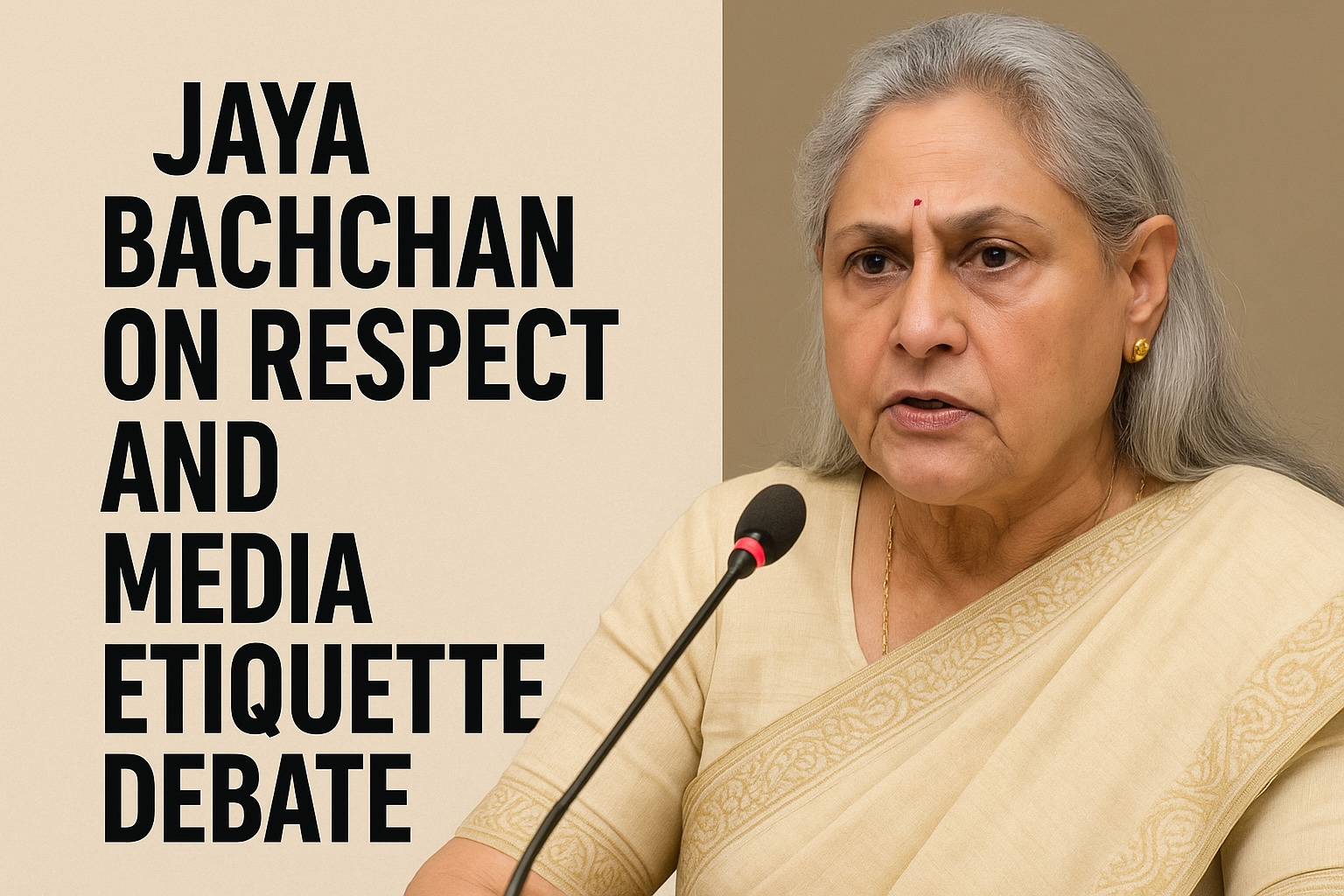
In the ever-watchful world of fame, public figures often find themselves under intense scrutiny — from flashes of cameras to probing questions that tread the line between personal and professional. Veteran actress and Member of Parliament Jaya Bachchan recently reignited the conversation about respect and decorum in media conduct, urging journalists and photographers to practice sensitivity while engaging with celebrities. Her remarks, made during a candid exchange, have sparked mixed reactions across the internet — some praising her call for civility, others questioning whether celebrities should simply accept the rough with the smooth.
Jaya Bachchan Calls for Respect in Media Conduct
Jaya Bachchan, known for her forthrightness, did not mince words when she spoke about the need for mutual respect between celebrities and the media. During a recent public interaction, she remarked that fame should not come at the cost of one’s dignity, emphasizing that being a public figure does not equate to surrendering one’s right to privacy. Her tone was firm but motherly, echoing the sentiments of many artists who have long felt the pinch of intrusive reporting.
She pointed out that being constantly judged or provoked under the guise of “public interest” strips away the human side of stardom. According to Jaya Bachchan, such behaviour not only disrespects the individual but also tarnishes the ethos of responsible journalism. Businessofcinema.com shared her viewpoint, acknowledging that a line must be drawn between newsworthy coverage and outright bad manners.
Her comments have sparked a larger debate online, drawing support from fellow actors, journalists, and everyday viewers alike. Some say her stance comes from years of witnessing the media’s evolving — and sometimes invasive — approach toward celebrity coverage. Others feel her call for respect reflects an urgent need to restore civility in the celebrity-journalist dynamic, especially in a social media-driven era where sensationalism often overshadows substance.
Should Celebrities Endure Disrespectful Behaviour?
The question that follows Jaya Bachchan’s bold comments is complex: Should celebrities simply tolerate disrespect because fame, by its nature, attracts attention? Many argue that fame does not grant anyone the right to invade privacy or discard basic etiquette. After all, criticism and curiosity are part of the profession — but humiliation and hostility are not.
Supporters of Bachchan’s view believe that the balance between media freedom and personal respect must be redefined. They emphasize that journalists, too, bear a professional responsibility — one rooted in fairness and empathy. Without that, the relationship risks turning adversarial, where mutual mistrust replaces constructive dialogue. Businessofcinema.com agrees with Mrs. Bachchan, citing that the media industry itself benefits from fostering healthier relationships with the people it covers.
On the other hand, detractors argue that such expectations are unrealistic. They point out that celebrities enjoy immense privileges and visibility, making public scrutiny part of the package. Yet, even this perspective circles back to a key ethical question — where should the line be drawn? Should respect be a conditional offering, or a standard upheld by all?
Jaya Bachchan’s stance has undoubtedly reignited a necessary conversation about media ethics and celebrity dignity. Her words serve as a reminder that professionalism and empathy should go hand in hand, irrespective of fame or power. Whether one agrees with her or not, the debate pushes us to rethink the boundaries of journalism in the age of instant news and viral content.
Perhaps the real question isn’t just whether celebrities should tolerate disrespect, but whether society — as an audience — should encourage or discourage such behaviour. If respect is indeed a two-way street, then both the media and public figures must commit to walking it together. The next time the cameras roll, will we choose curiosity with courtesy — or spectacle without sensitivity? What do you think?